
全國熱線服務:
新聞資訊 Top label
- The Complete Guide to Pressure Sensors: Technology, Applications, and Selection Criteria
- The Evolution and Advantages of Electro-Hydraulic Synchronous Press Brakes in Modern Manufacturing
- Revolutionizing Semiconductor Manufacturing: The Role of Electrostatic Chucks in Modern Wafer Processing
- What Is A Humidity Sensor? How Does It Affect Our Lives And Work?
- The Essential Guide to Modern Bending Machines: Technology, Applications, and Selection Criteria
- The Complete Guide to Modern Hospital Beds: Transforming Patient Care Through Advanced Design
What is the difference between cold drawn pipe and hot rolled pipe?
1. Hot rolling
Advantages: It can destroy the casting structure of the steel ingot, refine the grains of the steel, and eliminate defects in the microstructure, thereby making the steel structure dense and improving the mechanical properties. This improvement is mainly reflected in the rolling direction, so that the steel is no longer isotropic to a certain extent; bubbles, cracks and looseness formed during pouring can also be welded under the action of high temperature and pressure.
Disadvantages: 1. After hot rolling, the non-metallic inclusions (mainly sulfides, oxides, and silicates) inside the steel are pressed into thin sheets, causing delamination (interlayering). Delamination greatly deteriorates the tensile properties of the steel along the thickness direction and may cause interlaminar tearing as the weld shrinks. The local strain induced by weld shrinkage often reaches several times the yield point strain, which is much larger than the strain caused by load; 2. Residual stress caused by uneven cooling. Residual stress is the internal self-balanced stress in the absence of external force. Hot-rolled steel sections of various sections have such residual stress. Generally, the larger the cross-section size of the section steel, the greater the residual stress. Although residual stress is self-balanced, it still has a certain impact on the performance of steel components under the action of external forces. For example, it may have adverse effects on deformation, stability, fatigue resistance, etc. 3. Hot-rolled steel products are difficult to control in terms of thickness and edge width. We are familiar with thermal expansion and contraction. Even if the length and thickness are up to standard after hot rolling at the beginning, there will still be a certain negative difference after cooling. The wider the side width and the thicker the thickness, the more obvious this negative difference will be. Therefore, for large-sized steel, the side width, thickness, length, angle, and edge lines of the steel cannot be too precise.
2. Cold rolling
It refers to processing steel plates or steel strips into various types of steel through cold drawing, cold bending, cold drawing and other cold processing at normal temperature.
Advantages: fast forming speed, high output, and does not damage the coating. It can be made into a variety of cross-section forms to adapt to the needs of use conditions; cold rolling can cause large plastic deformation of steel, thereby increasing the yield point of the steel.
It is prone to torsion when subjected to bending and torsional buckling when subjected to pressure, and its torsional resistance is poor; 3. The wall thickness of cold-rolled formed steel is small, and there is no thickening at the corners where the plates are connected, so the ability to withstand localized concentrated loads is weak.
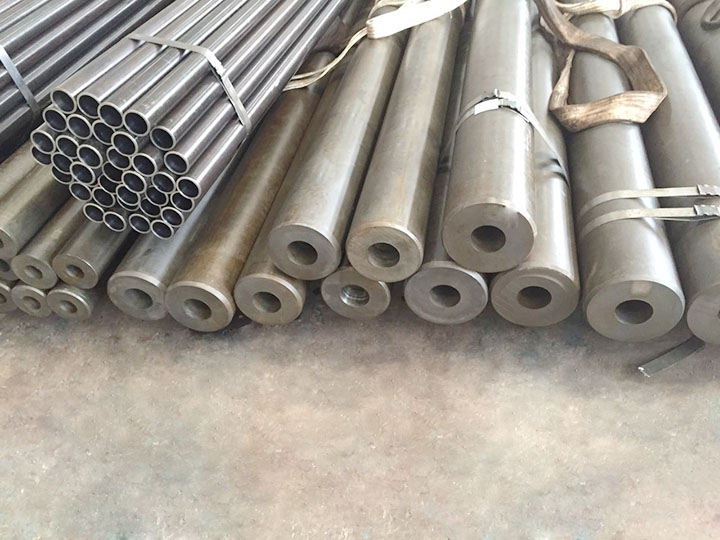 Rolled tube Click to view product details |
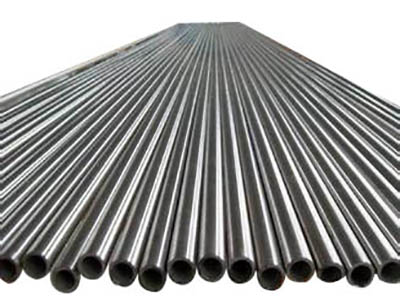 High precision cold drawn tube Click to view product details |
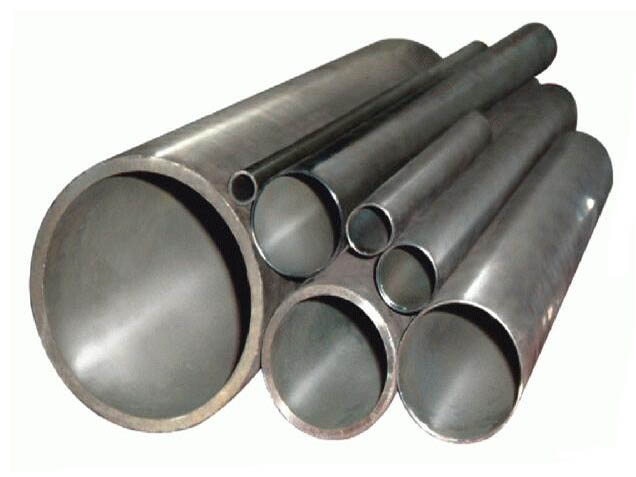 Honing tube Click to view product details |
3. The main difference between hot rolling and cold rolling is:
1. Cold-rolled formed steel allows local buckling of the section, so that the bearing capacity of the rod after buckling can be fully utilized; while hot-rolled section steel does not allow local buckling of the section.
2. The causes of residual stress in hot-rolled steel and cold-rolled steel are different, so the distribution on the cross-section is also very different. The residual stress distribution on the cold-formed thin-walled steel section is curved, while the residual stress distribution on the hot-rolled steel or welded steel section is film-type.
There is not much difference in the finished product between the two steel pipes. They are generally manufactured according to standards. There is no difference in mechanical properties.
Most of them are due to different processing techniques and different final accuracy. Generally speaking, cold drawing has higher dimensional accuracy and surface finish.
Hot rolling process: tube blank---heating---perforation---rolled pipe---sizing---cooling bed---straightening---pipe cutting---inspection---packing---delivery
Cold drawing process: tube blank---heating---piercing--hot rolling (two-piercing), etc.---heading--pickling--phosphating--cold drawing--annealing (heading can be repeated in multiple passes to the subsequent process)---straightening--cutting---inspection---packaging---delivery
As an important part of steel products, steel pipes are divided into two categories: seamless steel pipes (round billets) and welded steel pipes (plates, strip billets) due to their different manufacturing processes and shapes of the pipe blanks used.
(1) Seamless steel pipe
Because of their different manufacturing processes, they are divided into two types: hot-rolled (extruded) seamless steel pipes and cold-drawn (rolled) seamless steel pipes. Cold drawn (rolled) pipes are divided into round pipes and special-shaped pipes.
a. Process overview
Hot rolling (extruded seamless steel pipe): round tube blank→heating→perforation→three-roll cross rolling, continuous rolling or extrusion→tube removal→sizing (or diameter reduction)→cooling→ billet tube→straightening→hydraulic test (or flaw detection)→marking→warehousing.
Cold drawn (rolled) seamless steel pipe: round tube blank→heating→perforation→heading→annealing→pickling→oil coating (copper plating)→multi-pass cold drawing (cold rolling)→ billet tube→heat treatment→straightening→hydraulic test (flaw detection)→marking→warehousing.